
The honest answer to how long should a freight quote take is split. On lanes you can price yourself—from a rate card, contract, or a carrier's live rate you can read—the quote should go out within the same business hour. If you must wait on a partner agent or carrier desk, the standard is the same day, with an acknowledgement sent in minutes. Every enquiry deserves an answer.
The critical distinction is not the transport mode, but who you are waiting for. An ocean quote from your own rate card can and should go out as fast as an express quote. The wait belongs to whoever holds the rate. This article sets a defensible standard for your quote desk, shows what the published evidence says about industry performance, and explains what slow and unanswered quotes cost. For a complete overview, see the complete guide to freight quoting.
How long forwarders actually take
Published mystery-shopper evidence shows the industry default has been days, and more often, silence. The gap between a defensible standard and actual performance is where opportunity lies.
The 2016-2018 findings: days, not hours
A multi-year series of tests by Freightos, where researchers posed as shippers requesting spot quotes, painted a stark picture of freight quote turnaround times. In a late 2016 test of the top 20 forwarders, a simple manual spot quote took 101 hours on average. According to the report in Air Cargo News, only 9 of the 20 forwarders provided a quote, and just three of them followed up.
The trend continued in Freightos’s third annual mystery-shopper report. As reported by Air Cargo Week in March 2018, forwarders who quoted manually took an average of 57 hours. Worse, the same report found that 72% failed to quote at all. The problem was not just speed, but silence.
The 2021 follow-up: silence remains the default
By 2021, the problem persisted. A subsequent Freightos mystery-shopper report found that 60% of quote requests still did not produce a quote. Of the 25 companies that did manage to quote, only two followed up. Across the series, the shape of the problem is consistent: quotes that arrive are slow, but most RFQs are simply lost to silence.
The clock your buy rates set
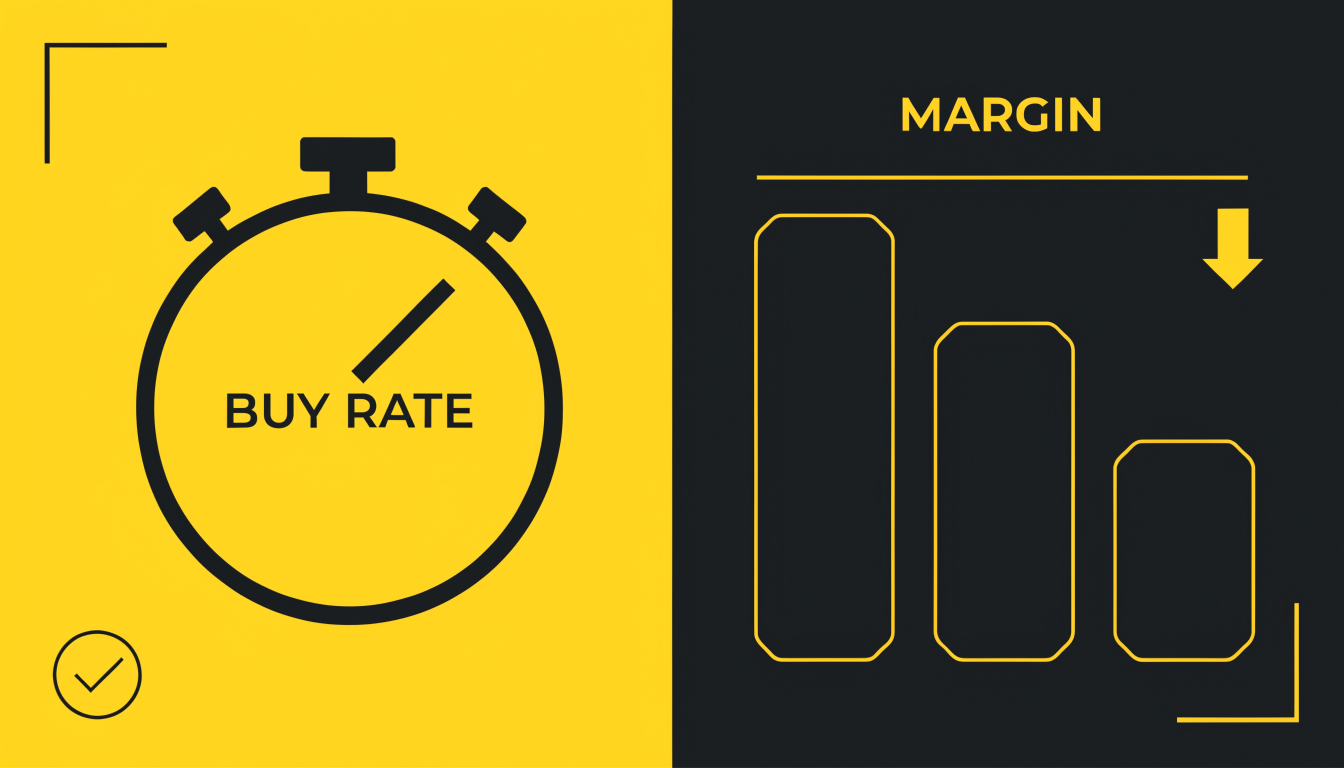
Your supplier's clock is ticking. A spot buy rate from a carrier, airline, or co-loader is not valid forever. It carries a validity window, often a short one on volatile lanes. This creates a hard commercial deadline for your quote desk.
The cost of an expired buy rate
If your team takes longer to produce a sell quote than the underlying buy rate stays valid, you face a damaging choice. You either re-check the rate with the supplier, adding more delay and risking a price change, or you pad the original sell price to cover potential drift. Padding protects your margin on that one shipment, but it makes your quote less competitive against a desk that priced on a fresh, unpadded rate. The quote that goes out first is the one the buyer reads first, and a buyer who has asked several forwarders will often move with the first credible answer.
The shipper's clock
The shipper’s clock runs in parallel. A buyer waiting for your price is also evaluating others. A delay on your part gives competitors a head start. While there is no universal rule, a quote that arrives after a decision has been made is commercially worthless. The speed of your response is a direct input to your win rate. This is especially true for rates sourced from carrier spot portals, where prices can be dynamic.
A turnaround standard by lane type
A single turnaround target for all quotes is an operating mistake. It forces simple, rate-card-based quotes to wait behind complex, partner-priced ones. The correct approach is to set the standard by lane type, defined by who holds the rate information. On air enquiries, the quote is only as fast as the weight check, so ask for dimensions first and see how to calculate chargeable weight.
A comparison framework for quote turnaround
Use this framework to set internal targets and measure quote desk efficiency. The standard changes based on whose clock the quote is running on—yours, or a partner's.
| Lane Type | Whose Clock It Is | Standard |
|---|---|---|
| Lanes priced from your own rate cards or contracts | Your clock | Acknowledge and issue a priced quote within the business hour. |
| Spot lanes where the carrier's live rate can be read | Your clock | Acknowledge and return the live-rate quote within the business hour. |
| Multi-leg or partner-priced lanes | The partner's clock | Acknowledge the enquiry in minutes; quote the same day, subject to partner response. |
| Enquiries you cannot serve | Your clock | Send a clear, polite decline the same day. |
Managing out-of-hours enquiries
For requests that arrive outside business hours, the standard is modified but the principle holds. An acknowledgement should go out on arrival, confirming receipt and setting the expectation for a response. The priced quote should then be delivered at the start of the next business day at the latest.
Measure two times per enquiry
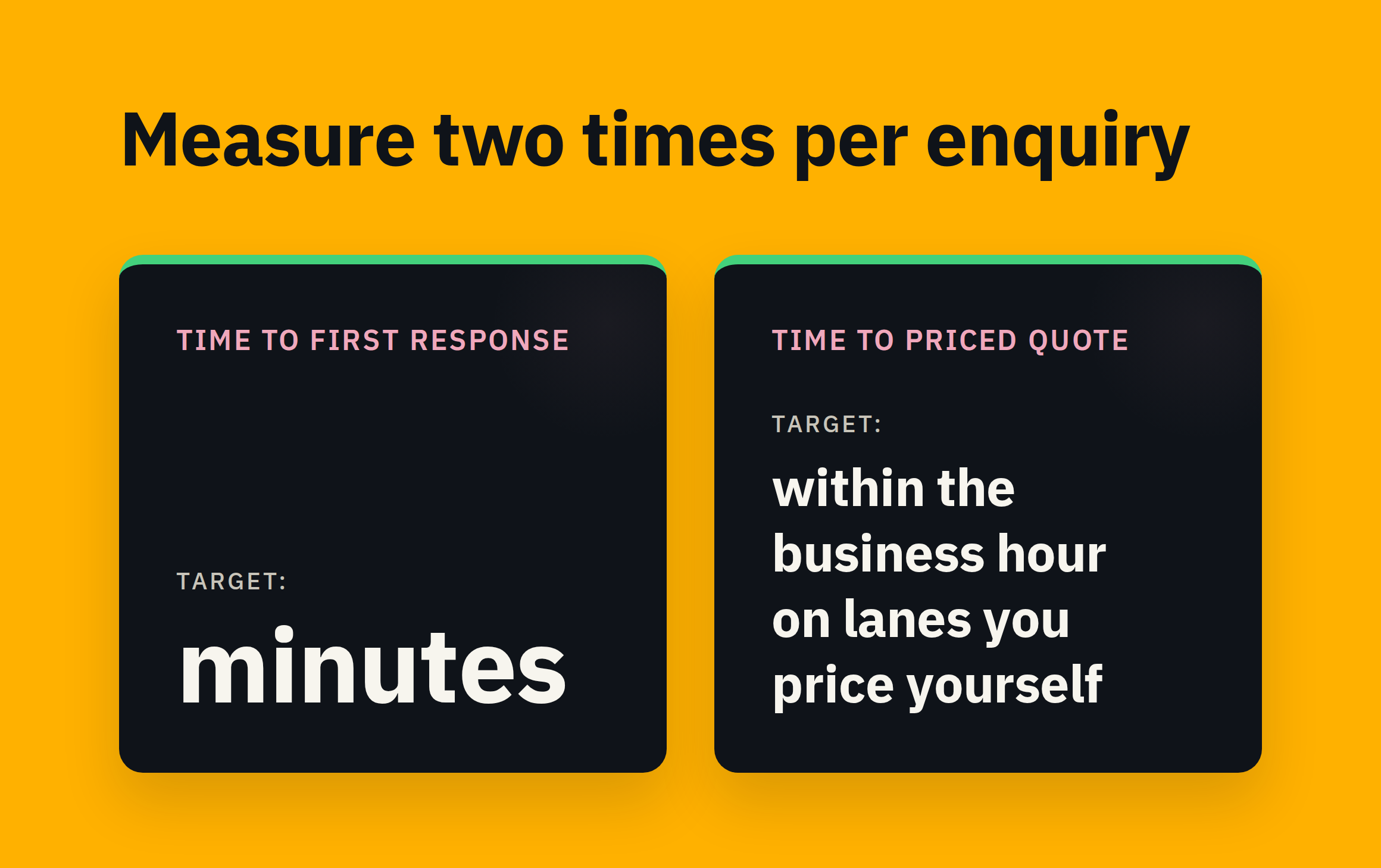
To get a true picture of performance, you must measure two separate metrics for every single enquiry:
- Time to first response: The time from when the RFQ is received to when the customer gets a meaningful acknowledgement that their request is being handled.
- Time to priced quote: The time from receipt to when the customer has a complete, bookable quote in their hands.
Tracking both exposes bottlenecks. A team might be fast to acknowledge but slow to price, or vice versa. Only by measuring both can you diagnose and fix the real problem with how long should a freight quote take at your desk.
What slow quotes cost
Slow and unanswered quotes carry direct and indirect costs that erode profitability. These are not abstract concepts; they are measurable losses in margin and opportunity.
Lost opportunity and competitive disadvantage
An unanswered enquiry cannot be won. It is a complete loss of a potential revenue opportunity. A late quote is not much better; it arrives in the buyer's inbox to compete against quotes that are already being considered. You are starting from behind. The cost of this silence is significant; see what it adds up to in the RFQs you never answer.
Margin leakage from rate drift
When your buy rate from a carrier expires, you must either absorb the price increase or go back to the customer with a new, higher price—a move that damages trust and can lose the shipment. This margin leakage is a direct, measurable cost of a slow quoting process. Every dollar lost to an expired rate comes straight from your gross profit.
Lower win rates from price padding
The alternative to risking margin leakage is to pad your quotes to create a buffer. While this protects the margin on shipments you do win, it makes your price less competitive overall. You win fewer deals. This trade-off between margin protection and win rate is a false choice, forced by an inefficient process. A fast, accurate quote based on a fresh buy rate needs no padding.
To put a hard number on these costs, you can work out what slow quotes cost your desk by inputting your own enquiry volume, win rate, and margins.
How to hit the standard
Meeting a one-hour or same-day standard is not about making your team work harder; it's about giving them a better way of working. The solution is to remove manual waiting and re-keying from the process wherever possible.
A process description for faster quoting
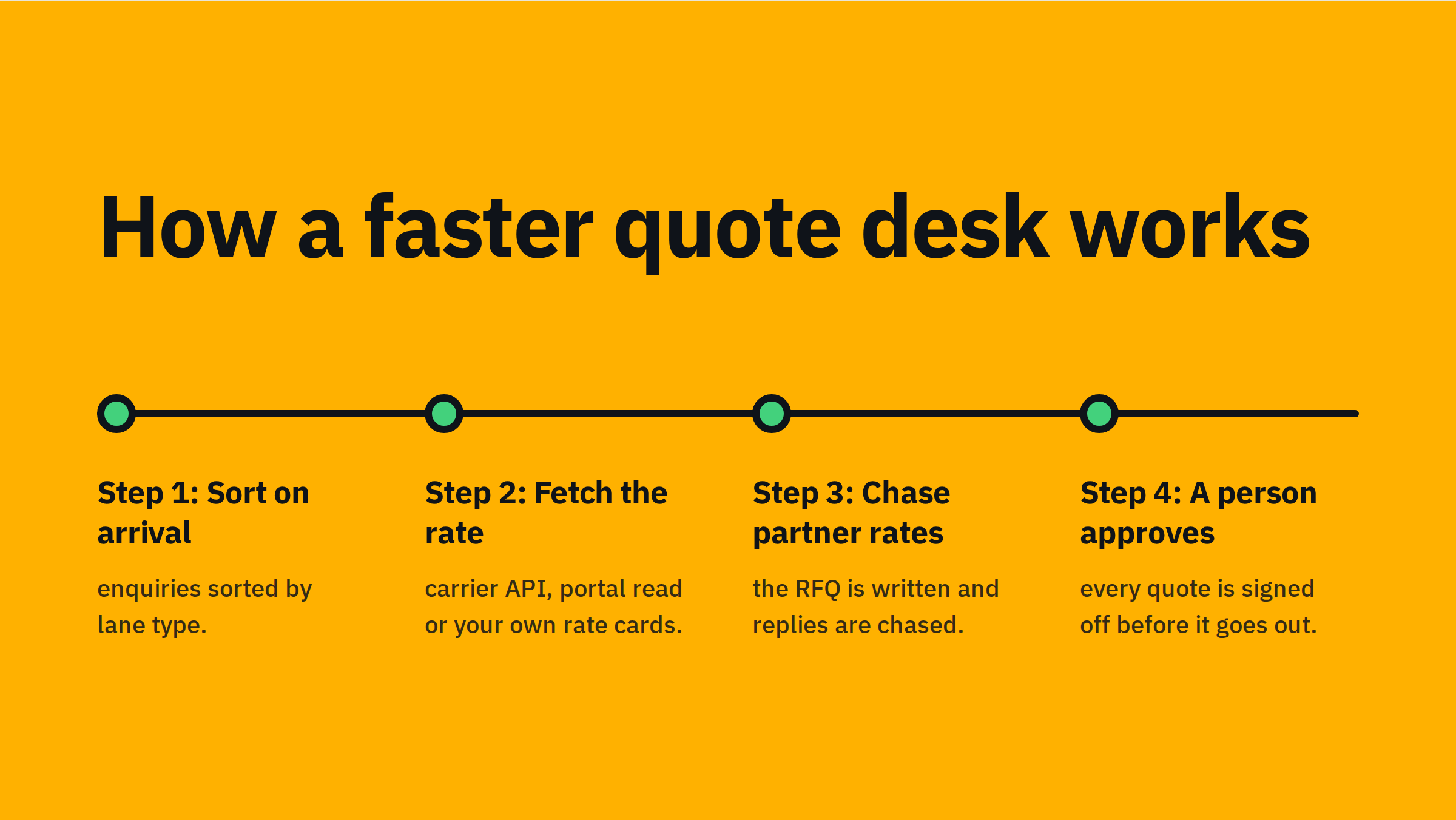
The first step is to sort enquiries by lane type the moment they arrive. A request for a lane on your rate card should never queue behind one that needs a price from an overseas agent. This simple triage ensures that fast-to-price quotes are handled immediately.
The next step is to take waiting on people out of the process wherever the rate is machine-reachable. Where the rate can be fetched without waiting on a person (a carrier API, a portal read in the background, or your own uploaded rate cards), a priced quote goes out in 10 to 15 minutes instead of 1 to 2 hours. That holds for ocean and air just as it does for express.
For lanes that do require a partner, the process changes. Where a lane has to be priced by another agent or over the phone, the wait belongs to whoever is answering; AI Quote Desk still writes the RFQ, chases the reply, and turns whatever comes back into a priced quote the moment it lands. This separates internal delay from external delay. Crucially, every message a customer sees waits for a person to approve it, ensuring your team retains full control.
A proven result
This approach delivers measurable improvements. Infinity Logistics, a UAE freight forwarder and integrator key-account reseller, runs its quote desk this way. According to the Infinity Logistics case study, average response time fell from more than 60 minutes to about 15 minutes, and the win rate rose from 35% to 73%. You can see how an AI quote desk compared with manual quoting works, step by step.
Ultimately, answering "how long should a freight quote take" is a question of process control. By structuring your workflow around who holds the rate, you can set and achieve a standard that wins more business. To see how this could apply to your own RFQs, See your own RFQ quoted live.
Frequently Asked Questions
What is a good freight quote turnaround time?
A good freight quote turnaround time depends on who holds the rate. For lanes you can price yourself using internal rate cards, contracts, or live carrier rates, a good standard is within one business hour. For more complex quotes that require pricing from an overseas partner or a carrier desk, the standard is to acknowledge the request in minutes and deliver the complete quote the same business day.
Why do freight quotes take so long?
Freight quotes often take a long time for three main reasons. First is waiting on external parties: getting rates from carriers, co-loaders, or partner agents can take hours or days. Second is manual work: pricing teams spend significant time re-keying data from emails into spreadsheets and quoting systems. Third is queuing: simple quotes often get stuck in line behind complex ones, delaying the entire process.
Should I acknowledge a request before the quote is ready?
Yes, absolutely. You should acknowledge every quote request within minutes of receipt. This first response should confirm you have received the request, thank the customer, and state when they can expect to receive the full, priced quote. This simple step manages customer expectations and shows that their enquiry is being handled professionally, even if the final price isn't ready yet.
Does the transport mode change the standard for how long a freight quote should take?
No, the transport mode (ocean, air, road) is not the primary factor that determines the standard for how long should a freight quote take. The real factor is who you have to wait on for the rate. An ocean FCL quote from your own contracted tariff can be faster to produce than a complex air freight quote that requires a special spot rate from an airline. The standard should be based on lane type (who holds the rate), not mode.
How can I measure my quote desk's performance?
To effectively measure performance, you need to track two key metrics for every enquiry: "time to first response" (how long it takes to acknowledge the request) and "time to priced quote" (how long it takes to deliver a complete quote). Additionally, you should measure your quote coverage rate (the percentage of enquiries that receive a quote) and your win rate. Analyzing these metrics by lane, customer, and team member will reveal your biggest bottlenecks and opportunities for improvement.
Sources & References
This article draws on research and data from the following verified sources:
From reading to seeing.
Every idea on this page runs live in a working quote desk. Bring a real RFQ and watch.
Book the live demoKEEP READING