
An air freight quote has three common failure points: the wrong divisor, missing dimensions, and the weight-break trap. Get any one wrong, and you either lose the shipment or lose your margin. The calculation itself is simple. Applying it correctly under pressure is what separates a winning quote from a costly error. This is not just theory; it is the daily work of a pricing desk, and getting it right is fundamental to the complete guide to freight quoting.
This article gives a quote-desk pricer a method to apply to any air enquiry. You will learn how to calculate chargeable weight, how to check the weight break before quoting, and which details to request when an RFQ arrives without them.
What chargeable weight is
Chargeable weight is a pricing mechanism, not a physical measurement. It exists to balance the two constraints of an aircraft: its payload capacity (weight) and its cargo hold capacity (volume). A shipment of steel is heavy but dense. A shipment of foam packaging is light but bulky. Airlines need to charge for both weight and space to operate profitably.
The Rule: Chargeable weight is the greater of the shipment's actual gross weight and its volumetric (dimensional) weight.
The Formula: Volumetric Weight (kg) = (Length cm × Width cm × Height cm) / 6000
Example: A 100 kg crate measuring 120 × 100 × 80 cm has a volumetric weight of (120 × 100 × 80) / 6000 = 160 kg. The chargeable weight is 160 kg.
Defining Chargeable Weight: Gross vs. Volumetric
Every air freight shipment has two weights. Understanding both is the first step in any chargeable weight calculation.
- Actual Gross Weight (GW): This is what the shipment weighs on a scale. It includes the product, its packaging, any pallets, and protective materials. It is the total physical mass of the cargo as tendered to the airline.
- Volumetric Weight (VW): Also called dimensional weight, this is a calculation of the shipment's volume converted into a weight equivalent. It represents the space the cargo occupies in an aircraft's hold.
The chargeable weight is simply the higher of these two figures. According to the International Air Transport Association (IATA), this principle ensures that the airline is compensated fairly, whether the cargo is dense or bulky.
Why Airlines Charge for Space
An aircraft can "full out" in two ways. It can either reach its maximum takeoff weight (payload limit) or run out of physical space in its cargo hold. If airlines only charged by gross weight, a full aircraft of light, bulky goods like empty plastic bottles would generate very little revenue, making the flight unprofitable. The volumetric weight calculation solves this by putting a price on space. It creates a minimum density expectation; cargo that is less dense than this standard is charged based on its volume, not its weight.
The formula: length × width × height ÷ 6000
The standard formula for calculating volumetric weight in air freight is straightforward. However, errors often arise from using the wrong divisor or incorrect measurements. Knowing how to calculate chargeable weight starts with mastering this formula and its variations.
The IATA Standard: The 6000 Divisor
For general air cargo, the industry-standard formula uses a divisor of 6,000. This is the IATA-endorsed method.
Volumetric Weight (kg) = (Length in cm × Width in cm × Height in cm) / 6,000
This ratio equates one cubic metre (1,000,000 cm³) to approximately 167 kg of chargeable weight. It is the default for most general air cargo.
The Express Carrier Divisor: 5000
A critical trap for pricers is assuming the 6,000 divisor is universal. It is not. Express integrators and courier services often use a divisor of 5,000.
Volumetric Weight (kg) = (Length in cm × Width in cm × Height in cm) / 5,000
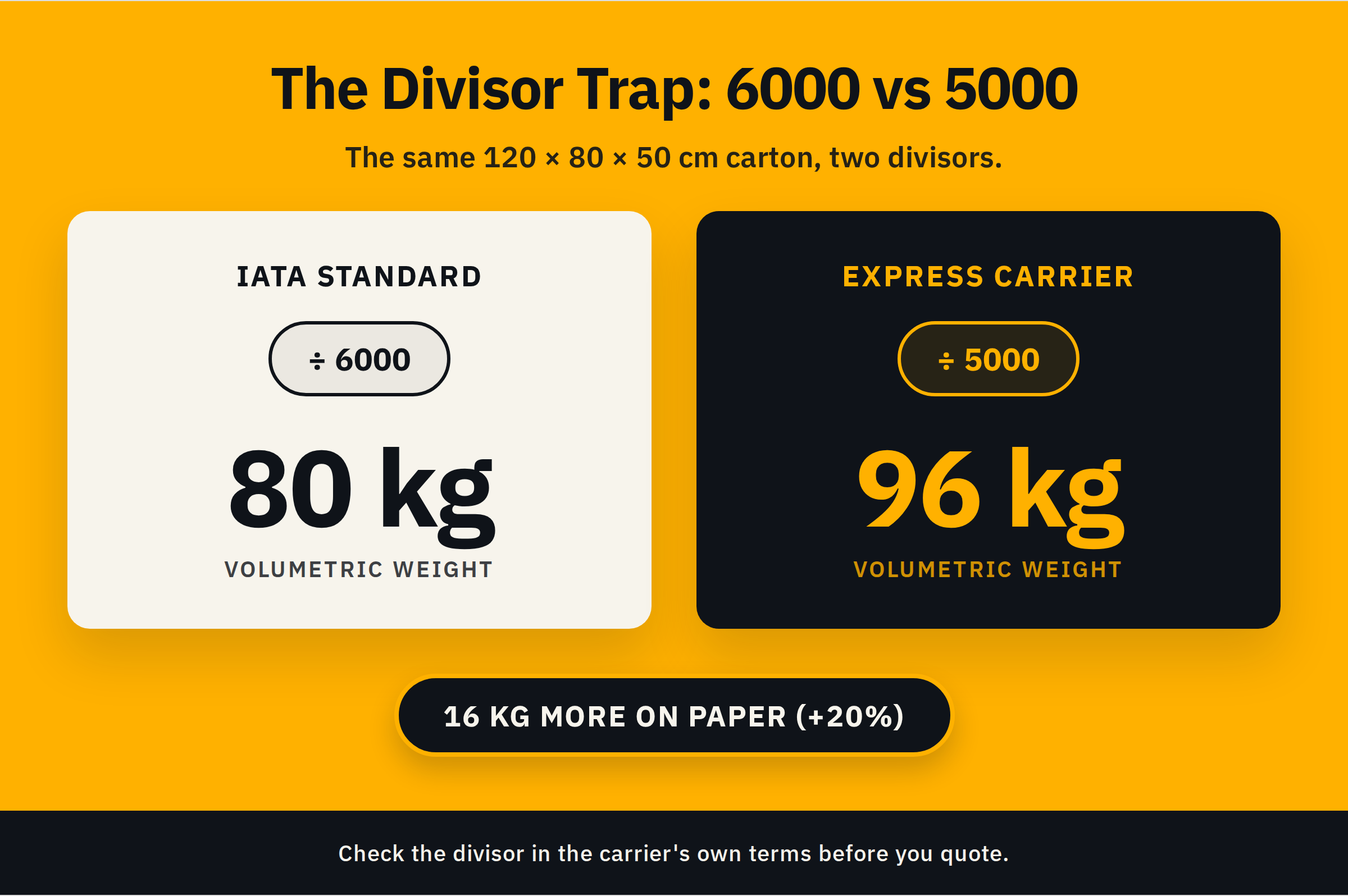
FedEx and DHL both publish a 5,000 divisor in their guides. That makes the same physical box 20% "heavier" on paper. A 120 × 80 × 50 cm carton is 80 kg VW with a 6,000 divisor, but 96 kg VW with a 5,000 divisor. Always check the carrier's own terms of carriage or rate card. The divisor is a commercial term, not a physical law.
How to Calculate: Piece by Piece
For shipments with multiple packages, calculate the volumetric weight for each piece individually and then sum the results. Do not average dimensions, as this can hide oversized pieces and lead to an incorrect total.
- Measure the outermost dimensions (length, width, height) of each package in centimetres. Always measure at the widest points.
- For each package, calculate its volumetric weight using the correct divisor.
- Apply the carrier's rounding rule to each piece's volumetric weight.
- Sum the volumetric weights of all packages to get the total volumetric weight for the shipment.
- Compare this total with the total actual gross weight of the shipment. The higher value is the air freight chargeable weight.
The Importance of Rounding Rules
Airlines have specific rules for rounding. A common rule is to round up to the next half-kilogram (0.5 kg). For example, a calculated weight of 24.1 kg becomes 24.5 kg. A weight of 24.6 kg becomes 25.0 kg. However, some carriers round to the next full kilogram. These small increments add up. Confirm the rounding rule in your carrier's tariff to protect your margin.
Three worked examples
The best way to understand how to calculate chargeable weight is to work through real-world scenarios. Here are three examples based on common freight lanes, each demonstrating a different outcome.
Example 1: Light and Bulky (Chennai to Singapore)
A shipment of garments is light but takes up significant space.
- Shipment: 12 cartons
- Dimensions per carton: 40 × 30 × 25 cm
- Total Actual Gross Weight: 18 kg
Step 1: Calculate volumetric weight of one carton.
(40 × 30 × 25) / 6000 = 5 kg
Step 2: Calculate total volumetric weight for the shipment.
5 kg/carton × 12 cartons = 60 kg
Step 3: Compare gross weight vs. volumetric weight.
Actual Gross Weight = 18 kg
Volumetric Weight = 60 kg
Result: The chargeable weight is 60 kg.
Takeaway: For light, bulky cargo, the volumetric weight is almost always higher. The airline charges for the space the shipment occupies.
Example 2: Palletised (Mumbai to Dubai)
When cargo is palletised, you must use the dimensions of the final, packed pallet.
- Shipment: 2 pallets
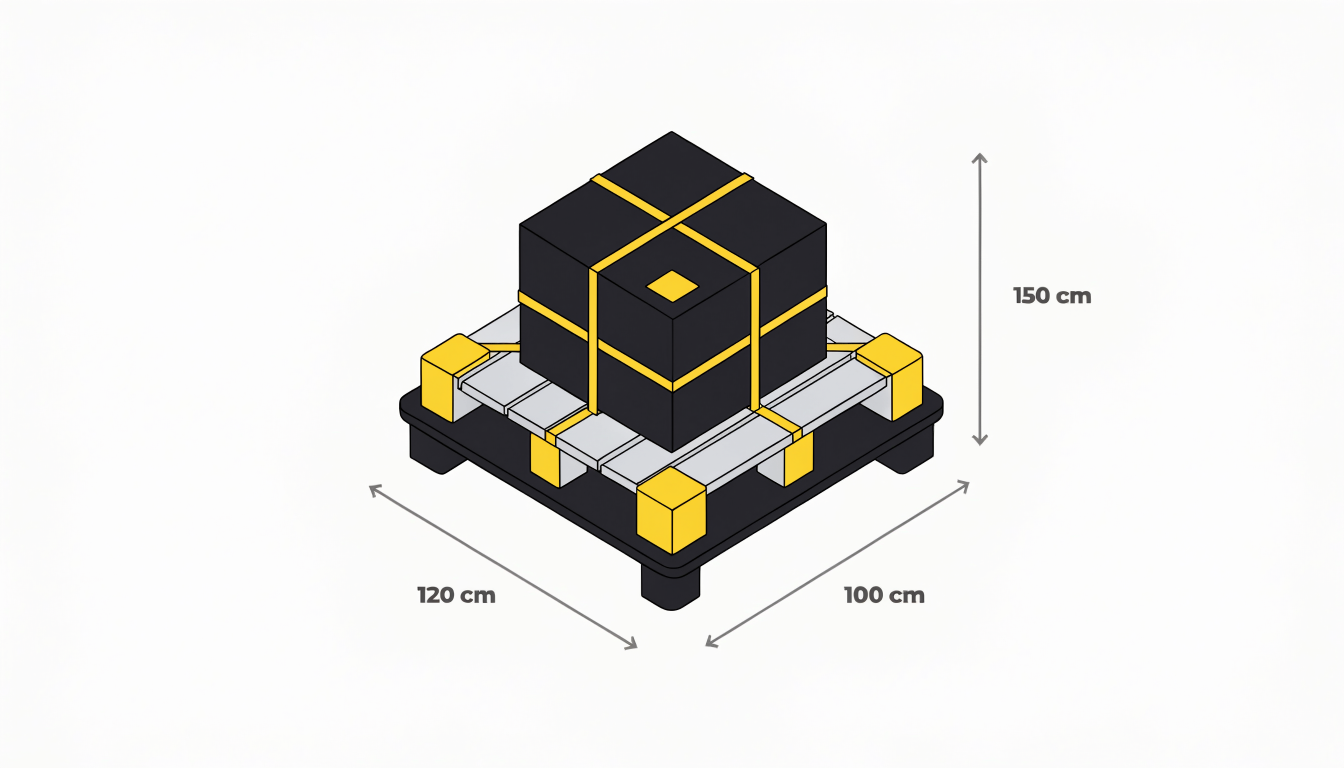
- Dimensions per pallet: 120 × 100 × 150 cm
- Total Actual Gross Weight: 380 kg
Step 1: Calculate volumetric weight of one pallet.
(120 × 100 × 150) / 6000 = 300 kg
Step 2: Calculate total volumetric weight for the shipment.
300 kg/pallet × 2 pallets = 600 kg
Step 3: Compare gross weight vs. volumetric weight.
Actual Gross Weight = 380 kg
Volumetric Weight = 600 kg
Result: The chargeable weight is 600 kg.
Takeaway: Pallets add volume. The final chargeable weight is based on the space the entire handling unit occupies, not just the cartons on it.
Example 3: Dense Cargo (Delhi to London)
A shipment of machine parts is heavy for its size.
- Shipment: 1 crate
- Dimensions: 80 × 60 × 50 cm
- Actual Gross Weight: 145 kg
Step 1: Calculate volumetric weight of the crate.
(80 × 60 × 50) / 6000 = 40 kg
Step 2: Compare gross weight vs. volumetric weight.
Actual Gross Weight = 145 kg
Volumetric Weight = 40 kg
Result: The chargeable weight is 145 kg.
Takeaway: For dense cargo, the actual gross weight is higher. The airline charges for the mass it has to lift.
The weight-break check: when a heavier band costs less
Calculating the chargeable weight correctly is only half the battle. The final freight cost depends on the carrier's rate structure, which is built around weight breaks. Ignoring this step is a classic quoting error that either loses the business or gives away margin.
Understanding Air Freight Rate Bands
Air freight rates are not linear. Carriers offer tiered pricing, where the cost per kilogram decreases as the shipment size increases. A typical freight forwarder rate card will show bands like this:
- M: Minimum charge (a flat fee for very small shipments)
- N: Normal rate (for shipments under 45 kg)
- +45 kg: Rate for shipments 45 kg and over
- +100 kg: A lower rate for shipments 100 kg and over
- +300 kg, +500 kg, +1000 kg: Progressively cheaper rates
This banded structure is a standard convention in air cargo tariffs. The exact bands and rates vary by carrier and lane, so read them from your own rate sheet.
The Pivot-Rate Calculation: When Heavier is Cheaper
The "weight-break trap" occurs when a shipment's chargeable weight falls just below the threshold for a cheaper rate band. In these cases, it can be cheaper to rate the shipment at the minimum weight of the next band to access its lower per-kilogram rate. This is known as a pivot-rate calculation or checking the freight weight break.
The rule is simple: calculate the total cost at the actual chargeable weight and its rate, then calculate the total cost at the next weight break's minimum weight and its rate. The carrier will charge the lower of the two totals.
Worked Example: The Weight-Break Trap in Action
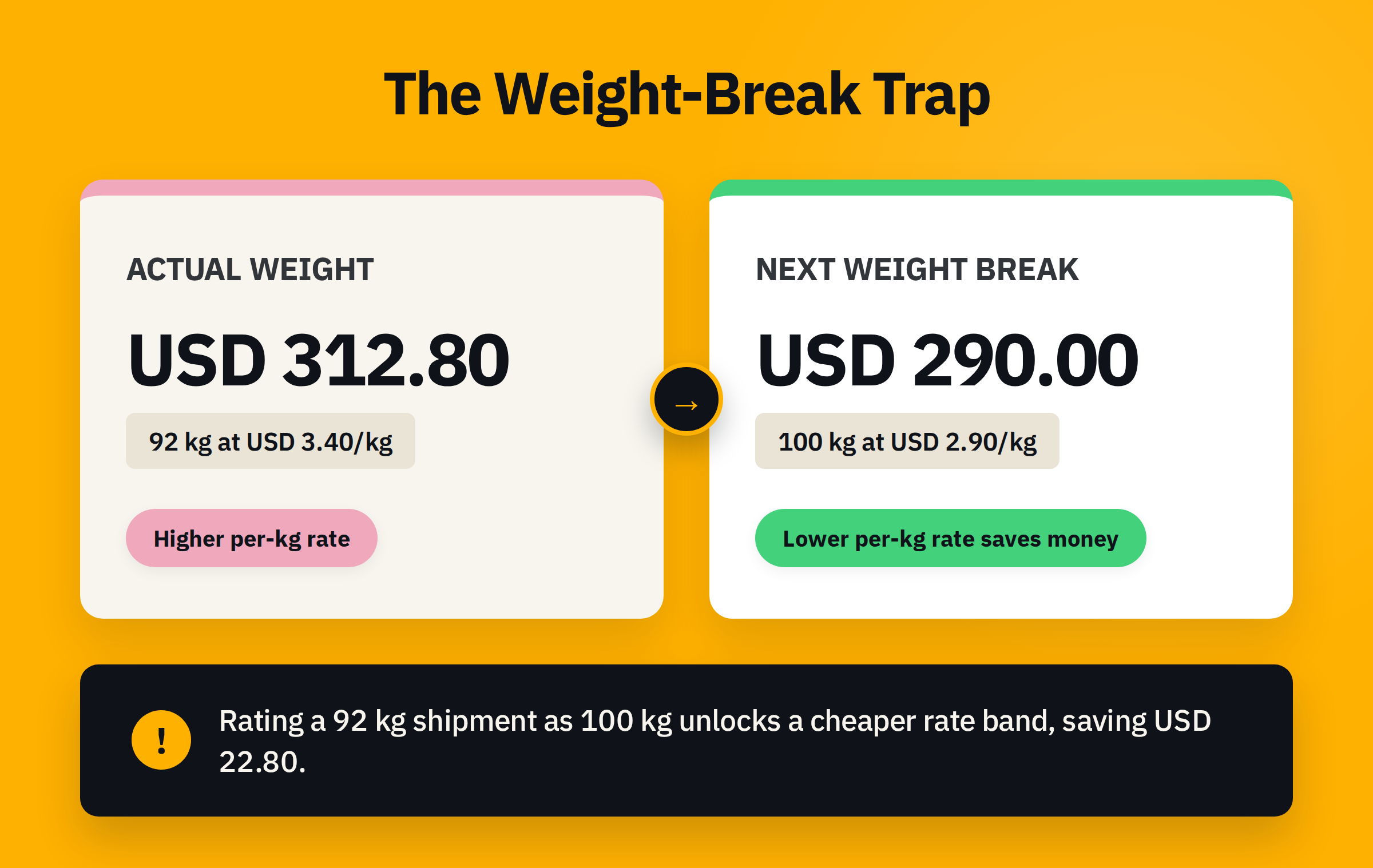
Imagine you have a shipment with a calculated air freight chargeable weight of 92 kg. Your carrier's rates are as follows (these are illustrative rates for this example):
- +45 kg rate: USD 3.40 / kg
- +100 kg rate: USD 2.90 / kg
A pricer who doesn't check the break would calculate:
Cost at actual weight: 92 kg × USD 3.40/kg = USD 312.80
A savvy pricer checks the next weight break:
Cost at next break's minimum weight: 100 kg × USD 2.90/kg = USD 290.00
Result: The correct freight charge is USD 290.00. You rate the shipment "as 100 kg" to get the lower total cost.
The Commercial Risk of Skipping the Check
A desk that skips this check quotes USD 312.80 when USD 290.00 was available on the same rate sheet. On a competitive enquiry, that USD 22.80 can be the difference between winning and losing the shipment. Make the check a fixed step in every air freight quote.
When the RFQ has no dimensions
Many RFQs arrive incomplete. A customer might email "price for 250 kg to London" or send a photo of a packing list. Quoting on weight alone is a significant risk. The final chargeable weight can only be determined with accurate dimensions.
The Four Details to Request Immediately
When an RFQ arrives with weight only, do not issue a firm quote. Instead, reply immediately and ask for the following four critical details:
- Number of pieces (cartons, pallets, crates, etc.)
- Dimensions per piece in centimetres (Length × Width × Height)
- Gross weight per piece
- Stackable or not?
Without dimensions, nobody can work out the chargeable weight, so no firm price is possible.
Why Quoting on Weight Alone Loses Trust
Providing a quote based on gross weight and then issuing a revised, higher invoice once the cargo is measured is a common source of customer disputes. The customer sees a price increase; the forwarder sees a necessary correction. This erodes trust and makes your quotes seem unreliable. It is always better to state that the quote is indicative and subject to final dimensions. This manages expectations and establishes your desk as professional and transparent.
How to Quote Provisionally
If you must provide an indicative price, state your assumptions clearly.
"This indicative quote is based on an actual gross weight of 250 kg. The final price is subject to confirmation of packed dimensions, as air freight is charged on the greater of actual or volumetric weight. Please provide the number of pieces and dimensions per piece for a firm quotation."This protects your margin and educates the customer on how to calculate chargeable weight for future enquiries.
How AI Quote Desk handles it
Reading each enquiry, chasing missing dimensions and drafting the reply is repetitive work, and it is where errors creep in under pressure. This is the work an AI quote desk takes off your pricer's plate.
From Unstructured RFQ to Draft Quote
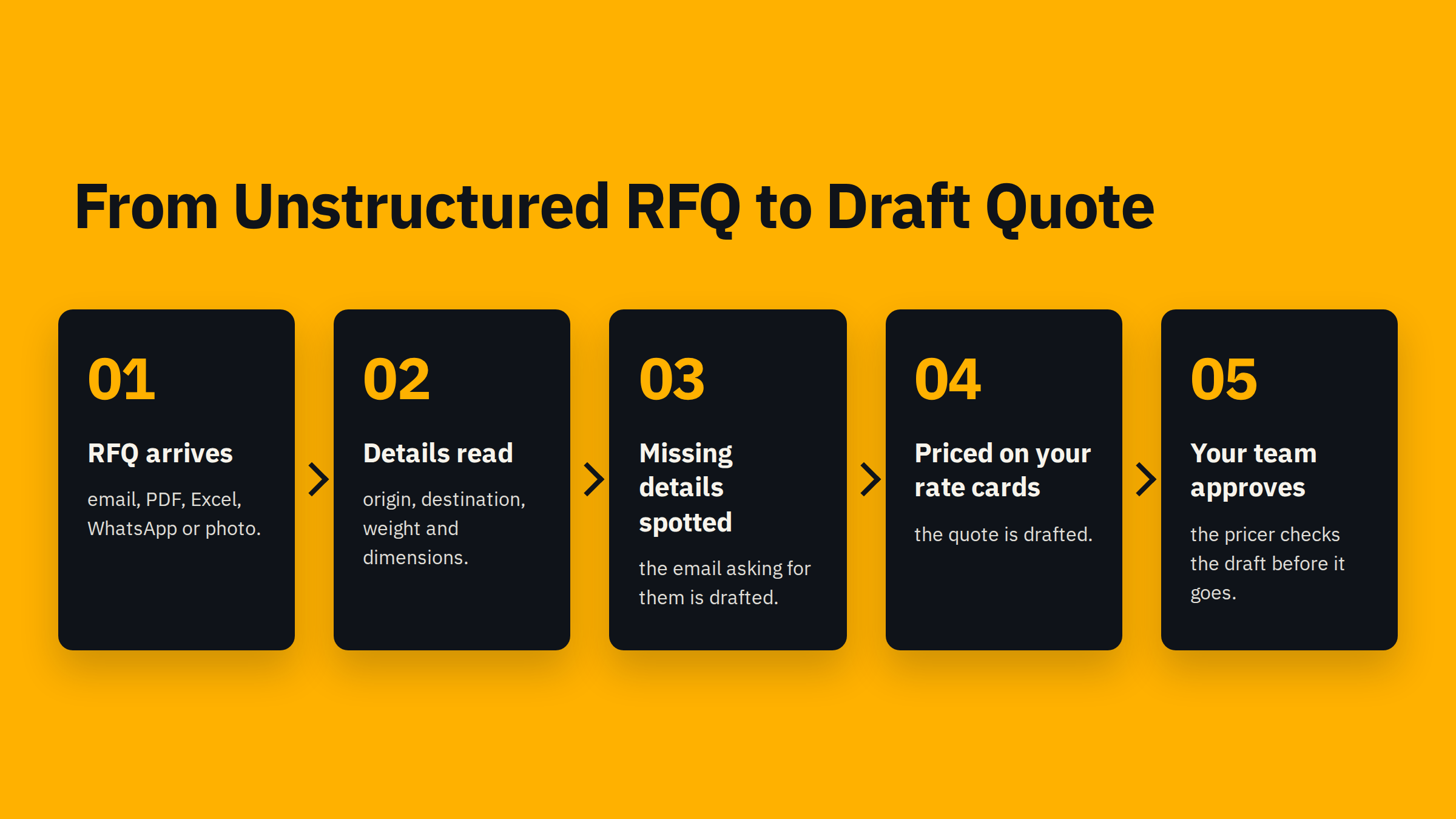
AI Quote Desk is built to handle the reality of freight enquiries. It reads RFQs in whatever form they arrive: PDF, Excel, forwarded email, or even a WhatsApp message with a photo of a packing list. The platform extracts the key data points—origin, destination, commodity, weight, and dimensions.
Crucially, it also spots what is missing. If an RFQ for air cargo arrives without dimensions, AI Quote Desk flags it and drafts the email asking for the necessary details. This simple step prevents inaccurate quotes before they are even created.
Priced on Your Own Rates
Once the details are complete, AI Quote Desk prices the enquiry on your own rate cards and drafts the quote, with a suggested price drawn from what that customer paid on that lane before, within your margin rules. Your pricer sees the draft beside the original enquiry and checks it before anything goes out. For the full picture, see manual quoting compared with an AI quote desk. A general chatbot can do the weight arithmetic too; where ChatGPT stops on a freight quote is everything after it.
The Human-in-the-Loop Advantage
Speed wins freight, but accuracy secures the profit. AI Quote Desk drafts the complete quote, but it never sends a message to a customer on its own. Every drafted quote waits for approval from your team. A pricer can review, edit, or reject the draft, ensuring commercial oversight is maintained. Your team approves every send. This combination of speed and control is proven in production. At Infinity Logistics, a forwarder in the UAE, the median time to draft a quote fell from about an hour to just 21 seconds.
Ready to see how this works on your own business? See your own RFQ quoted live and discover what that speed is worth to your desk.
Frequently Asked Questions
Is chargeable weight the same for air and express?
The principle is the same, but the formula often differs. Both air freight and express services use the greater of actual gross weight and volumetric weight. However, general air cargo typically uses a divisor of 6,000 cm³/kg, as per IATA standards. Express carriers like FedEx and DHL commonly use a divisor of 5,000. This makes the same package have a higher volumetric weight on an express service, so it is critical to use the correct divisor for the service being quoted.
Does sea freight use chargeable weight?
Yes, but the rule is different. For Less than Container Load (LCL) sea freight, the principle is known as Weight or Measure (W/M). The chargeable unit is the "revenue ton" (RT). The freight is charged on whichever is greater: the shipment's gross weight in metric tons or its volume in cubic metres (CBM). The standard LCL ratio is 1 CBM = 1,000 kg. This is a different calculation from the 1 CBM = 167 kg equivalent used in air freight.
Who decides the volumetric divisor?
The carrier decides the divisor. It is a commercial term set out in their tariff, service guide, or contract of carriage. While 6,000 is the IATA standard for general cargo and 5,000 is common for express, there is no universal law. A carrier can set any divisor they choose for a specific product, lane, or contract. Always verify the divisor from the carrier's own documentation before quoting.
What is the minimum charge in air freight?
A minimum charge (often abbreviated as 'M' on a rate sheet) is the lowest possible price a carrier will charge for a shipment, regardless of its weight or size. It covers the fixed administrative and handling costs associated with any shipment, even a very small one. If the calculated freight charge (chargeable weight × rate) is less than the minimum charge, the minimum charge will apply.
How do I know if I have calculated the chargeable weight correctly?
To verify your chargeable weight calculation, you need a clear audit trail. Your calculation should show: 1) The dimensions and gross weight for each piece. 2) The formula used, including the specific divisor (e.g., /6000). 3) The calculated volumetric weight for each piece, including any rounding. 4) The comparison between total gross weight and total volumetric weight. 5) The final chargeable weight selected. By documenting these steps, you can easily re-check your work and justify the final charge to a customer or colleague.
Sources & References
This article draws on research and data from the following verified sources:
From reading to seeing.
Every idea on this page runs live in a working quote desk. Bring a real RFQ and watch.
Book the live demoKEEP READING