
A margin floor is the lowest approved margin at which your desk will send a quote for a given lane or account without a named person's approval. It is an internal decision rule, not a market price. To make it work, you must set floors per lane and per account, size the negotiation buffer above them on purpose, and check the freight quote margin against the floor at sign-off. The floor only works if it is visible at the moment a quote is approved.
A written policy turns discounting from an accident under pressure into a decision someone owns. This article gives you a practical way to set and enforce a margin floor, with a copyable template. For a broader overview of the entire process, see the complete guide to freight quoting.
Why floors fail as intentions
Every quote desk has an intended floor. It breaks at the end of a long day, in the third round of a negotiation, or with a big customer threatening to move volume. An unwritten floor is an intention. A written policy is a control.
Pressure moments bend unwritten rules
An informal margin floor is most vulnerable at predictable moments. The salesperson wants to close before the carrier rate expires. The customer threatens to move a large RFQ elsewhere. After several rounds of negotiation, the internal reference point shifts from the target margin to “how much more can we concede?”
These are operational conditions. They are not reasons to abandon the floor. A floor that lives only in someone's head bends under that pressure. A freight quote is also time-bound and scope-specific, so the floor must apply to the complete, fully-costed quote, not just the headline freight rate.
A written policy gives the decision an owner
A written policy moves the decision away from the moment of maximum pressure. It makes the rule before the pressure arrives. It defines who owns the floor for a lane, who can approve an exception, and what evidence must be recorded. This turns a concession from an accident into an owned decision.
The policy should define the owner for each lane and account floor, the approver for exceptions, and the evidence required. This is consistent with the role of standard trading conditions in freight forwarding. As noted in guidance from FIATA, the International Federation of Freight Forwarders Associations, these conditions form the general contractual terms, and a commercial floor policy is an internal control that operates alongside them.
Setting floors per lane and per account
A single, global margin floor is a blunt instrument. Lane economics, service complexity, and account risk differ too much. Set floors per lane and per account, using both absolute dollar amounts and percentages. Review them whenever your buy rates or costs move.
Set floors per lane, not globally
Lane economics are not uniform. A floor for Nhava Sheva to Jebel Ali FCL should differ from one for Chennai to Los Angeles/Long Beach LCL. Factors include:
- Competition: Some lanes have more carrier and forwarder competition than others.
- Cost Volatility: A lane with frequent GRIs, peak-season surcharges, or disruption charges needs a higher floor to absorb risk.
- Handling Intensity: A simple port-to-port move is less work than a door-to-door shipment with customs, trucking, and multiple delivery points.
- Reliability: Unreliable lanes create more operational work. Delays and rebookings add work that the margin has to cover.
You can find live rates on different lanes using various tools; see our guide to how carrier spot portals compared.
Adjust floors per account
Two customers on the same lane do not necessarily justify the same floor. A strategic account with predictable volume and fast payments may earn a lower floor. An account that disputes invoices, changes bookings frequently, or pays slowly increases your cost-to-serve and credit risk. That account needs a higher floor, or a policy requiring prepayment.
The adjustment should be based on recorded data: payment history, dispute frequency, and operational touches per shipment. A large customer is not automatically a strategic one if they are unprofitable to serve.
Use both absolute and percentage floors
Many desks use both an absolute floor (e.g., $150 per container) and a percentage floor (e.g., 12% gross margin). This prevents two common errors:
- Small-shipment leakage: A percentage-only floor can approve a quote that makes too few dollars to cover the fixed costs of handling the shipment.
- Large-shipment leakage: An absolute-only floor can approve a low-margin quote on a high-value shipment, exposing you to disproportionate risk for little reward.
The rule should be to meet the higher of the two floors. Define your margin calculation clearly. Most use gross margin: (Sell Price - Buy Cost) / Sell Price.
Negotiation buffer: the gap between the opening quote and the floor
If a customer usually negotiates, your opening quote needs room to move. This negotiation buffer should sit above the margin floor. Size it based on that customer's history, not guesswork.
Size the buffer from account history
Do not apply a standard 5% or 10% buffer to every quote. Look at the data. For a specific customer on a specific lane, what is the median discount between your first offer and the final booked price? Use that history to set the buffer.
A customer who always asks for a 5% discount needs an opening quote with at least a 5% buffer above your floor. A customer who rarely negotiates needs little to no buffer. A structured a quote follow-up cadence can help you track this behavior.
The floor is not the opening price
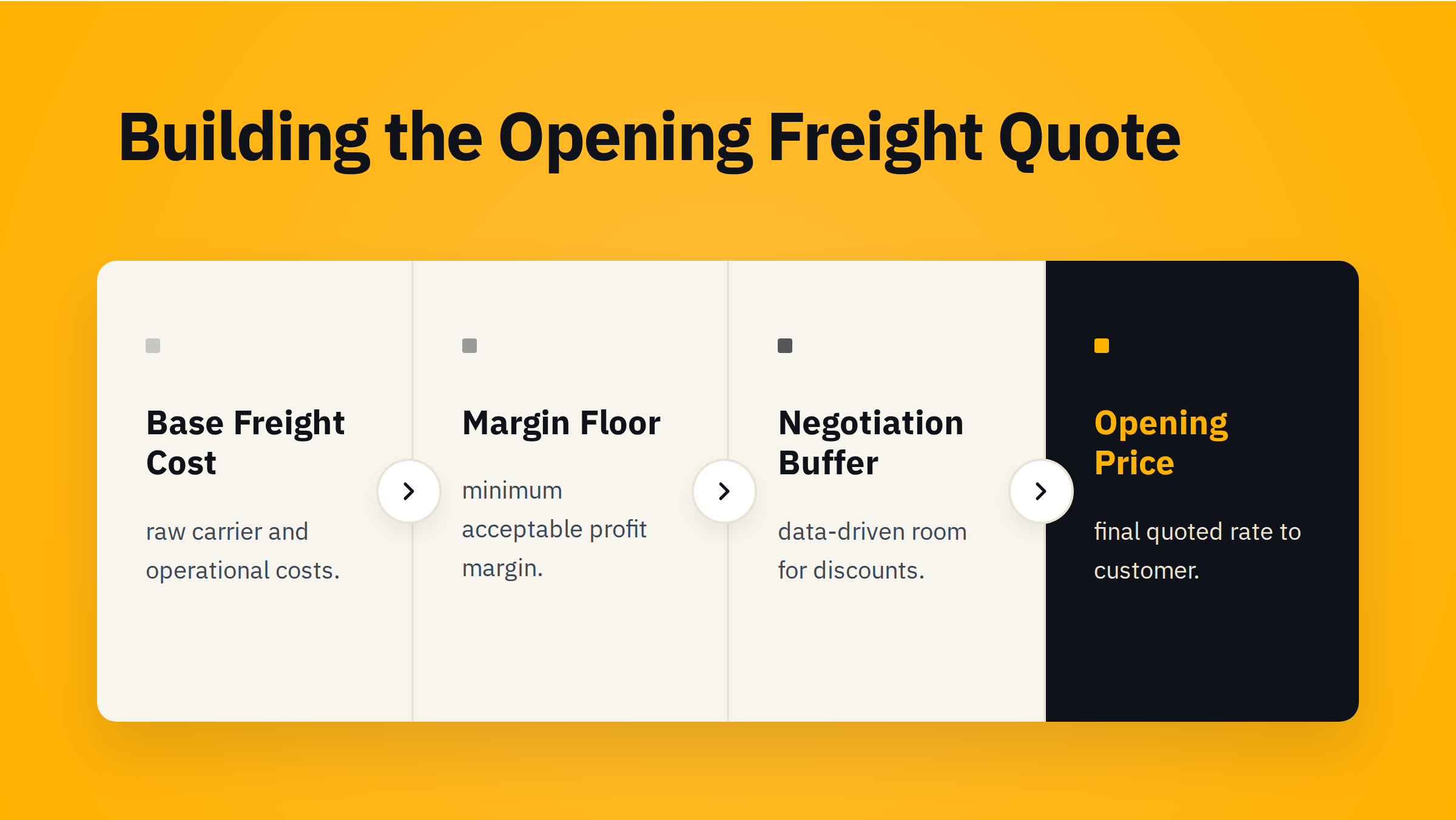
The most common mistake is to quote at the floor. If your floor is 12% and you quote at 12%, you have no room to negotiate without breaching your own policy. The buffer is the authorized room for the sales team to close the deal. The floor is the line that requires escalation.
Do not publish tiered floor models
Avoid complex "four-floor" or tiered-pricing models that are visible to the sales team. They create confusion and invite salespeople to start at a lower tier. The rule should be simple: one opening price, one buffer, and one hard floor. Any price below the floor needs a named approver.
The silent floor-breaker: missing surcharges
Many floor breaches are omissions, not discounts. A missing terminal handling charge (THC) or an out-of-date fuel surcharge can destroy your margin. The quote looks compliant, but the real margin is below the floor. Check for surcharge completeness before you check the margin.
Omissions are the most common breach
A quote can meet a 15% margin target on paper. But if you forgot to include the destination THC, your real margin is much lower. These errors are common because surcharges are complex, carrier-specific, and time-sensitive.
Terminal handling charges and local charges vary by carrier, by port, by container size and by cargo type, and they change. If your quoting sheet holds a single “THC” or “port charge” value, it is probably wrong for some quotes.
How to check for surcharge completeness
Your quoting process must force a check of all applicable buy-side surcharges. This includes:
- Origin and destination THC
- Fuel or Bunker Surcharges (Bunker Adjustment Factor, BAF)
- Peak Season Surcharges (PSS)
- Security Surcharges (ISPS)
- Congestion or emergency surcharges
- Documentation fees
A two-step check: completeness, then margin
The correct process is:
- Completeness Gate: Confirm all applicable surcharges from the carrier's current tariff are included in the buy cost.
- Margin Test: Calculate the margin using this complete, all-in buy cost.
Who can go below the floor
A floor without an exception process is too rigid. But exceptions must be controlled. Name the approver for each level of discount, record the reason, and review all below-floor approvals monthly.
Create a clear approval matrix
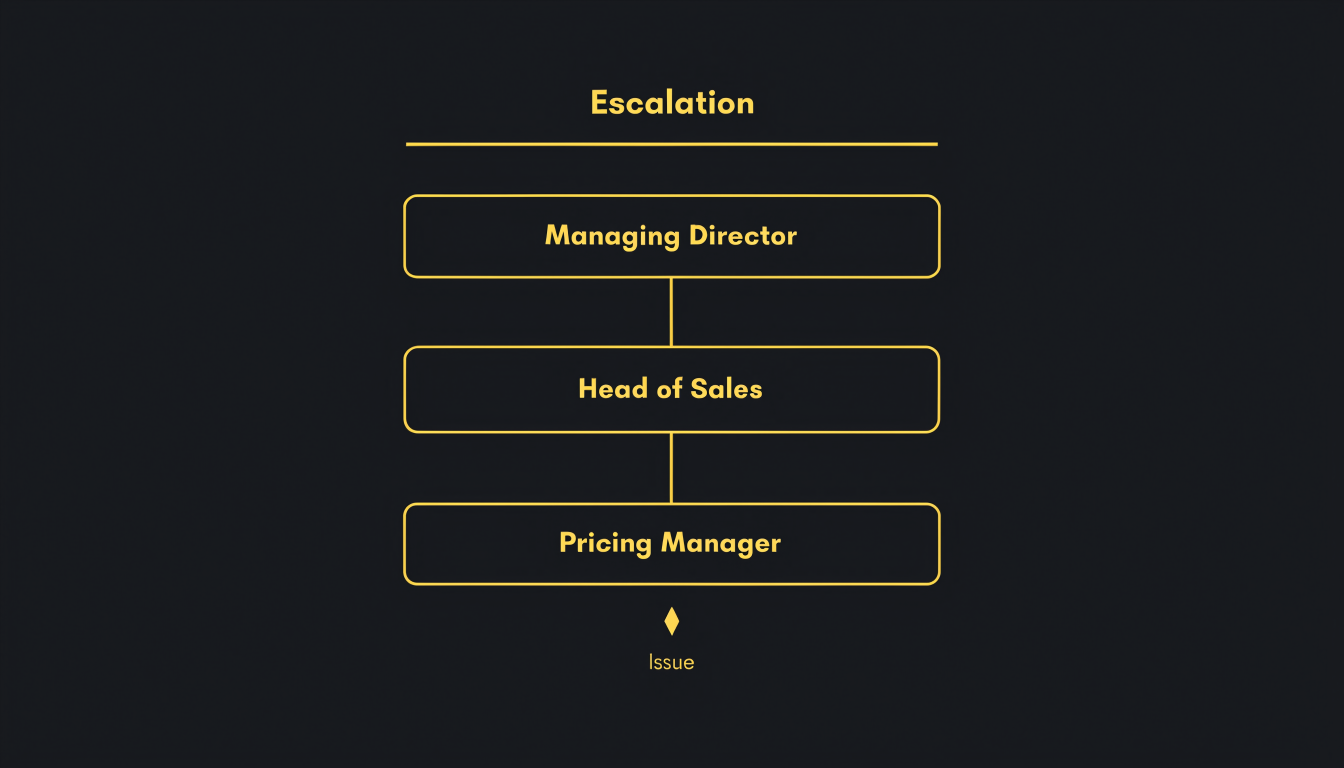
Your policy should name the role authorized to approve an exception. A simple matrix might look like this:
- Up to 2 points below floor: Pricing Manager
- 2-5 points below floor: Head of Sales / Commercial Director
- Any quote below variable cost: Managing Director / Owner
The key is that the salesperson cannot approve their own exception. Authority must be explicit and separate from the person making the request.
Record the reason for every exception
Every below-floor quote needs a documented reason. Do not accept "competitive pressure" as a reason on its own. Require specifics:
- Strategic Trial: A time-limited test of a new lane or customer.
- Volume Commitment: The customer has committed in writing to a specific volume.
- Competitive Match: A verified competing quote is attached to the record.
This creates an audit trail. It ensures that margin is being given away for a calculated commercial reason, not just to close a deal.
Review below-floor approvals monthly
The pricing manager should run a monthly report of all below-floor quotes. Review it with sales and finance leadership. Look for patterns. Is one salesperson always requesting exceptions? Is one customer constantly getting them? Is a specific lane always unprofitable?
This review closes the loop. It tells you if your floors are set correctly and if your exception policy is working.
The floor-policy template
Use this table as a starting point for your written policy. Copy it into your operations manual, TMS, or CRM. The policy only works if it is documented and accessible to your team.
The copyable template
This template helps ensure every quote decision is explicit. The validity of supplier rates is critical. Set review dates that match how long your supplier rates stay valid.
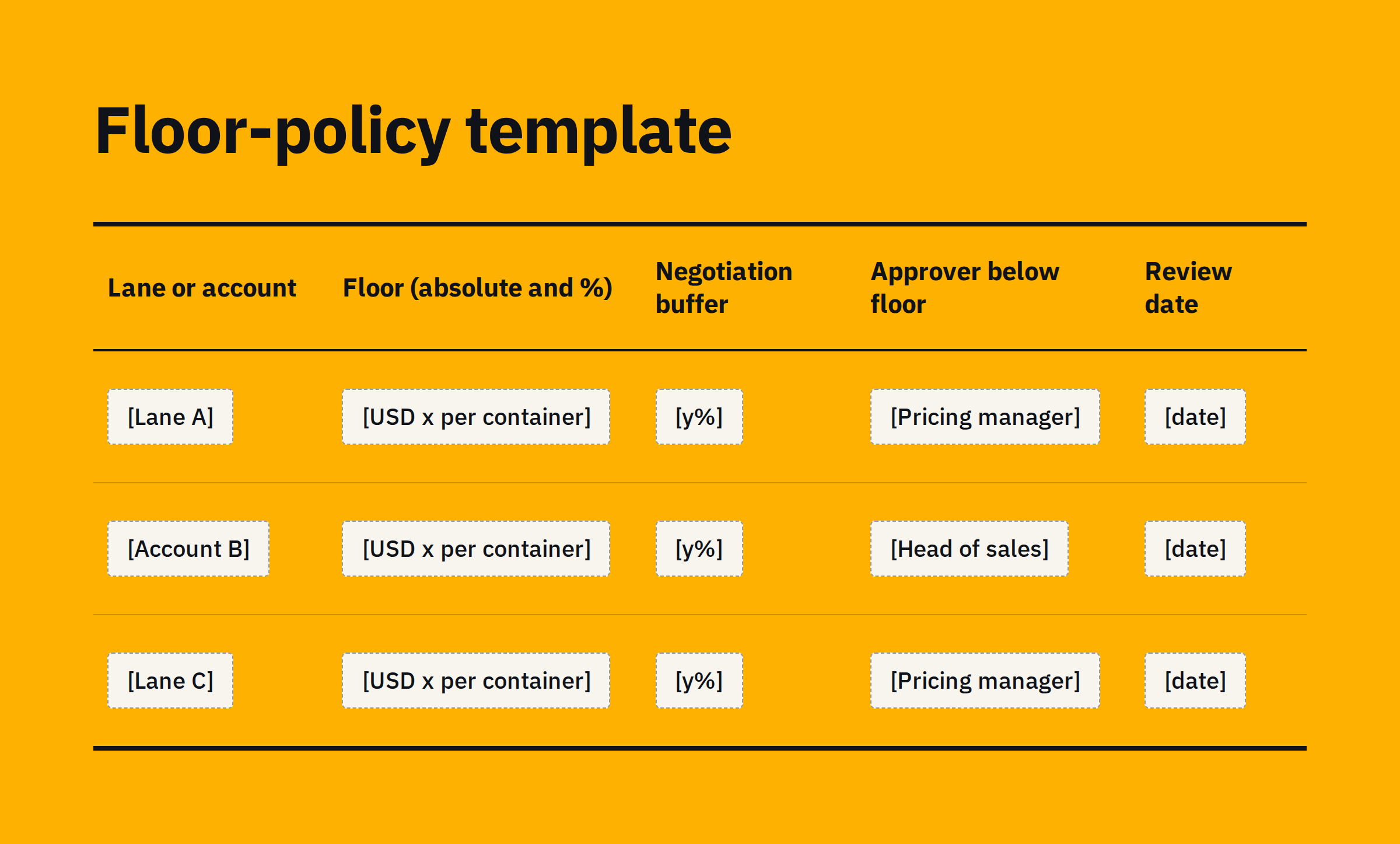
| Lane or account | Floor — absolute and % | Negotiation buffer | Approver below floor | Review date | Notes |
|---|---|---|---|---|---|
| [Nhava Sheva → Felixstowe, FCL, 40'HC] | [$___ contribution] / [__% gross margin] | [$___ or __ percentage points] | [Pricing Manager] | [DD-MMM-2026] | [Carrier quote valid through ___; all-in cost basis] |
| [Mundra → Jebel Ali, LCL, named account] | [$___ contribution] / [__% gross margin] | [$___ or __ percentage points] | [Branch Manager] | [DD-MMM-2026] | [Verify co-loader validity and destination accessorials] |
| [Strategic Account: [Name], Air Freight] | [$___ per kg] / [__% gross margin] | [__ percentage points] | [Head of Sales] | [DD-MMM-2026] | [Customer-specific exception expires on ___; based on volume commitment] |
How to use the template fields
- Lane or account: Be specific. Include origin, destination, mode, and equipment.
- Floor: Record both the absolute dollar amount and the percentage.
- Negotiation buffer: The approved room for negotiation above the floor.
- Approver below floor: The named role who can authorize an exception.
- Review date: Set a date to review the floor, triggered by changes in carrier rates or market conditions.
- Notes: Capture assumptions like supplier rate validity, included/excluded charges, and free time.
Where AI Quote Desk fits
A written policy is the foundation. Technology can help you apply it consistently. AI Quote Desk, built on the FreighAI platform, works as a quoting assistant for your team, not as an automatic margin enforcer.
An assistant, not an enforcer
AI Quote Desk sits between the RFQ and your team's approval. It suggests a price from what that customer paid on that lane before, within your margin rules. When the customer pushes back on price, a counter-offer is drafted and waits for approval. The key is that every message a customer sees waits for a person, who can edit, approve or reject it. The person at sign-off is responsible for keeping the quote above the floor.
How the floor works in an assisted workflow
The system provides the data; your team makes the decision. Before approving a quote drafted by AI Quote Desk, your operator confirms the cost basis is current, all surcharges are included, and the final margin meets the floor set in your policy. This combines the speed of an AI-drafted quote with the commercial control of a human expert. You can see how a freight quote desk compared with generic AI tools provides more control for this specific workflow.
A written policy, visible at the moment of approval, turns your margin floor from an intention into a reliable commercial guardrail. To see how this works in practice, see your own RFQ quoted live.
Frequently Asked Questions
What is a margin floor in freight quoting?
A margin floor is a freight forwarder's internal minimum acceptable profit for a quote. It is the lowest margin, expressed as a percentage or an absolute dollar amount, at which a quote can be sent to a customer without requiring special approval from a designated manager. It is a commercial control to protect profitability, not a market-wide standard.
Should margin floors be per lane or global?
Margin floors should be set per lane and per account, not as a single global number. Different trade lanes (e.g., Nhava Sheva to Felixstowe vs. Mundra to Jebel Ali) have different cost structures, levels of competition, and risk profiles. Likewise, different customers present different levels of credit risk and service intensity. A granular approach allows you to price more accurately and protect your profitability where it's most at risk.
How big should the negotiation buffer be?
The negotiation buffer—the difference between your opening quote and your margin floor—should be sized based on the specific customer's negotiation history, not a generic percentage. Analyze past quotes for that customer to see the typical discount they receive. If a customer consistently negotiates a 5% discount, your buffer should be at least 5% above your floor. For customers who don't negotiate, a smaller buffer is appropriate.
What usually breaks a margin floor?
While direct discounting is a common cause, a margin floor is just as often broken by omissions. Missing or outdated surcharges—such as terminal handling charges (THC), fuel surcharges, or peak season surcharges (PSS)—are a frequent source of margin erosion. A quote can appear to meet the margin floor on paper, but if the buy-cost calculation is incomplete, the actual margin will be lower. A robust quoting process checks for surcharge completeness before it checks the margin percentage.
How do I implement a margin floor policy?
Start by creating a written document that defines your floors. Use a template to set floors for key lanes and accounts, specifying both absolute dollar and percentage minimums. Define a clear approval matrix naming who can authorize exceptions. Train your sales and pricing teams on the policy, emphasizing the need to check surcharge completeness. Finally, implement a monthly review of all below-floor exceptions to identify patterns and adjust your floors as needed.
From reading to seeing.
Every idea on this page runs live in a working quote desk. Bring a real RFQ and watch.
Book the live demoKEEP READING