
Most freight quotes are lost to silence, not to price. A disciplined follow-up cadence turns that silence into a decision. This article gives your pricing or sales team a practical day-2, day-5, day-10 sequence for every quote you send, with three copy-ready templates. For a deeper look at the entire process, see the complete guide to freight quoting.
The short answer
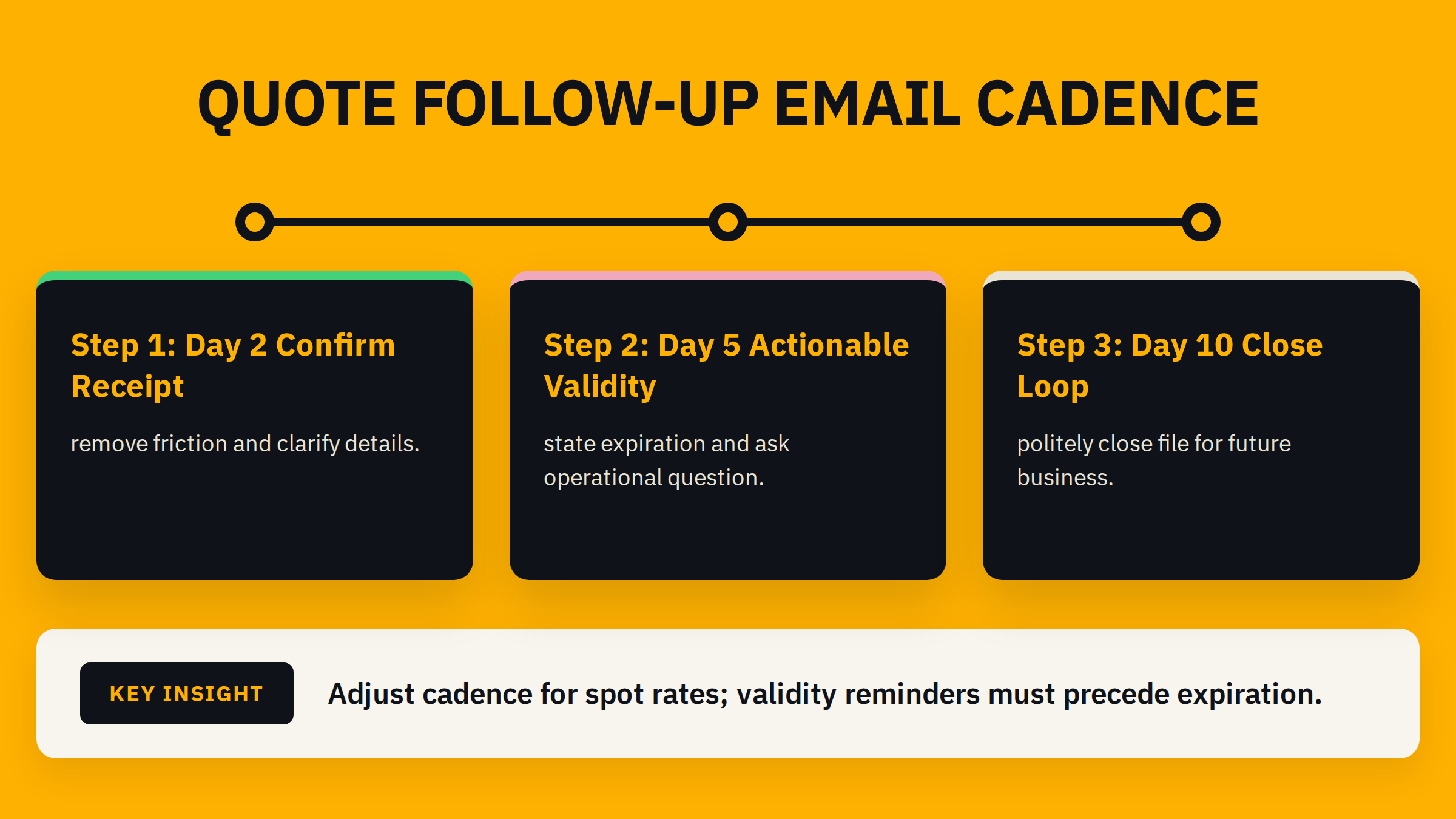
A freight quote follow-up should happen three times. First, on day 2 to confirm the customer received it and to answer any immediate questions. Second, on day 5 to flag the rate's validity and ask a specific operational question. Third, on day 10 to politely close the loop and keep the door open for the next shipment. Each quote follow up email must add new, useful information, not just say "checking in."
This simple cadence keeps your quote top-of-mind and signals to the shipper that you are organised and attentive. The goal is to get an answer—yes, no, or not yet—and prevent the RFQ from going cold. Stop the sequence as soon as the customer replies.
Why follow-up wins quotes
A consistent follow-up strategy gives you an immediate advantage because most forwarders don't do it. The data is stark: many quotes are never sent, and those that are rarely get a follow-up.
The Data: A Massive Quoting Gap
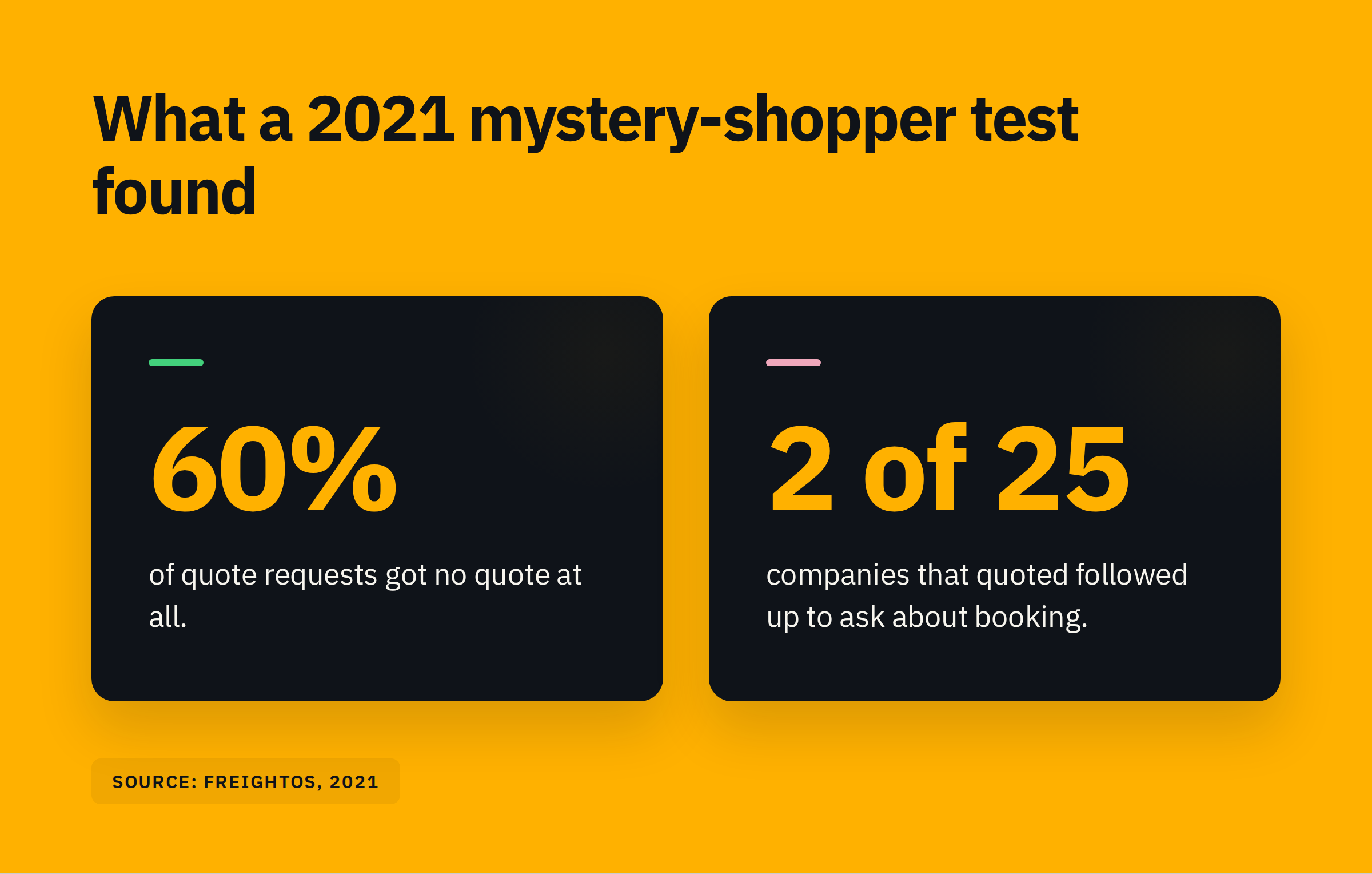
In a 2021 mystery-shopper exercise, Freightos found that 60% of quote requests sent to freight forwarders did not produce a quote at all. Of the 25 companies that did manage to send a quote, only two—just 8%—followed up to see if the shipper wanted to book.
This reveals two major leakage points in the typical sales process:
- Most RFQs are lost before a quote is even sent. These are the RFQs you never answer.
- Of the quotes that do go out, most get no follow-up: in that test, 23 of the 25 companies that quoted never checked back.
The Perception: Staying in Touch Wins
When a shipper is comparing several quotes for a lane like Nhava Sheva to Felixstowe or Mundra to Jebel Ali, the prices and transit times can be very close. In these situations, the forwarder who stays in touch often wins the business. A well-timed quote follow up email is not a nuisance; it’s a sign of good customer service. It shows your team is proactive and organised, and it gives the shipper a simple way to ask questions or request adjustments.
The Process: Turning Silence into a Signal
A structured freight quote follow up process turns silence into a clear signal. If the customer doesn't reply after three attempts, you can confidently close the file and focus your team's time elsewhere. This prevents your pipeline from filling up with dead or dormant opportunities and ensures your sales or pricing desk is working on live shipments.
The cadence: day 2, day 5, day 10
A day-2, day-5, day-10 cadence provides a structured, predictable rhythm for your quotation follow up. Each step has a distinct purpose, moving the conversation from confirmation to a clear decision point. The timing relates to, but is different from, how long a freight quote should take to prepare.
Day 2: Confirm Receipt and Remove Friction
Two days after sending the quote, send a short email to confirm it was received. The goal is to remove any initial friction or uncertainty. Restate the key details (lane, mode, validity) and offer to answer questions about inclusions, exclusions, or assumptions. This is your chance to clarify if the rate is port-to-port or door-to-door, or if it includes specific surcharges.
Day 5: Make Validity Actionable
This is the most critical email in the sequence. State the quote’s exact valid-until date and what happens after it expires—namely, that the rate and space will need to be re-checked with the carrier. Ask one specific, operational question, like "Is the cargo-ready date still [date]?" This is easier for the shipper to answer than a vague "Any update?"
Day 10: Close the Loop Politely
If you haven't heard back by day 10, it's time to close the loop. Assume the shipment has moved on or been postponed. This email should be polite and low-pressure. It states that you are closing the file for now but are ready to re-quote when needed. This professional closing leaves the relationship intact for future business and keeps your pipeline clean.
Adjusting the Cadence for Spot Rates
This cadence is a baseline. You must adjust it to the rate's validity. If you've sent a spot rate from a carrier that expires in 48 hours, the day-5 email is too late. In that case, the validity reminder becomes your day-2 email. The rule is simple: the validity reminder must go out before the rate expires, giving the customer time to act.
Template 1: day 2, the check-in that adds value
This first quote follow up email is a simple check-in that confirms receipt and opens the door for clarification. It shows you're on top of the details without being pushy.
The Day-2 Follow-Up Email Template
Subject: Checking your [lane] [mode] quote
Hi [Name],
I’m checking that you received our quote sent on [date] for your shipment from [lane] by [mode]. The rate is valid until [validity date].
If it's helpful, we can adjust the quote for a different routing, equipment type (e.g., 20'GP, 40'HC), or Incoterm (e.g., FOB, DAP).
Is there anything missing from the quote or anything you'd like to clarify?
Best regards,
[Your Name]
[Your Company]
Why This Template Works
This email is effective because it's short, direct, and helpful. It restates the core information and proactively offers to make adjustments. Mentioning specific variables like routing, equipment, and Incoterms shows you understand the shipper's potential decision points.
Template 2: day 5, the validity reminder
This email introduces urgency by focusing on a real, operational deadline: the rate's expiration date. It shifts the conversation from "if" to "when."
The Day-5 Follow-Up Email Template
Subject: Rate validity for your [lane] shipment
Hi [Name],
Just a quick note on the quote for your [lane] shipment. The rate is valid with the carrier until [date]. After that, we'll need to re-check pricing and space availability, and the rate may change.
To secure this option, could you let me know if the cargo-ready date is still planned for [date]?
Once I have that, I can confirm if this option is still the right fit or check for alternatives.
Best regards,
[Your Name]
[Your Company]
Why This Template Works
This freight quote follow up works because it creates a clear decision point tied to a real-world constraint. Carrier rates are not permanent; every quote carries a validity period. By stating this clearly, you're not creating false urgency; you're providing useful information. Asking a single, specific question about the cargo-ready date makes it easy for the shipper to reply with a concrete piece of data, which you can then use to move the booking forward.
Template 3: day 10, the polite close
The final email in the cadence is designed to close the opportunity cleanly, gather feedback if possible, and maintain a positive relationship for the next RFQ.
The Day-10 Follow-Up Email Template
Subject: Closing the loop on your [lane] quote
Hi [Name],
I'm closing the loop on our quote for the [lane] shipment. I'll assume it has either moved with another provider or been postponed.
If you chose another option, would you mind sharing the main reason in one line (e.g., price, transit time, schedule)? Your feedback is valuable and helps us improve.
No need to reply if it's no longer active. I'll close this file and look forward to quoting your next shipment.
Best regards,
[Your Name]
[Your Company]
Why This Template Works
This email relieves pressure on the shipper. By assuming the opportunity is closed, you make it easy for them to either confirm it or correct you. The request for a one-line reason for loss is a low-friction way to gather competitive intelligence. Most importantly, it ends the interaction on a professional and helpful note, making it more likely the shipper will contact you for their next RFQ.
Mistakes that make follow-ups backfire
A poor follow-up strategy can be worse than none at all. It can make your operation look disorganised and unprofessional. Here are four common mistakes to avoid in your freight quoting workflow.
Mistake 1: Sending 'Just Checking In' With Nothing New
An email with no new information is just noise. Each message must add value or move the decision forward. Instead of "just checking in," provide an update on the sailing schedule, confirm a cut-off date, or offer an alternative service level. Every touchpoint is a chance to demonstrate your expertise and proactivity.
Mistake 2: Following Up After the Customer Has Replied
Sending an automated chaser after the customer has already replied signals that your systems are disconnected and you aren't listening. Your follow-up cadence must stop the moment a reply is received. If a customer asks a question, the next step is to answer it, not send the next scheduled email.
Mistake 3: Chasing an Expired Rate Without Re-checking It
Never ask a customer if they are ready to proceed on a rate that has already expired. This undermines your credibility. The correct process is to acknowledge the expiry, re-check the rate with the carrier, and issue a refreshed quote with a new validity date. This shows you manage your suppliers and rates professionally. Knowing this can help you calculate what speed is worth to you.
Mistake 4: Sending From an Unrecognised Shared Mailbox
A follow-up from a generic `quotes@` or `sales@` address can feel impersonal and may even be filtered as spam. A quote follow-up email works best when it comes from the same person who sent the original quote, or at least a named individual. It maintains the personal connection and ensures the conversation stays in a single, easy-to-follow thread.
Where AI Quote Desk fits
Implementing and managing a manual follow-up cadence for hundreds of quotes is a significant operational challenge. This is where a dedicated tool can provide the necessary structure and automation, working alongside your team.
Human-Approved Automation
AI Quote Desk, built on the FreighAI platform, automates the operational work of the follow-up cadence. Follow-ups, chasers, and reminders happen on their own, on the same conversation thread. However, every message a customer sees waits for a person, who can edit, approve, or reject it. The approved message goes out in their own name, from their own email address, maintaining that crucial personal touch.
Configurable Rules for Your Workflow
Your business is unique, and your follow-up strategy should be too. With AI Quote Desk, the rules and timing for chasers and reminders are set by the head of operations or an admin. You can define your own day-2, day-5, day-10 cadence, and quote expiry rules are set by the pricing executive. Chasers can be switched off for a specific customer or lane, giving you full control. This provides the benefits of automation without the rigidity, a key difference when comparing an AI quote desk compared with manual quoting.
A Proven Result
At Infinity Logistics, which runs its quote desk on AI Quote Desk, the win rate rose from 35% to 73%; the Infinity Logistics case study sets out the numbers.
Ready to see how a structured, automated follow-up process could work for your team? See your own RFQ quoted live.
Frequently Asked Questions
How soon should I follow up on a freight quote?
You should send your first follow-up email approximately two working days after sending the initial quote. This gives the shipper enough time to review it without letting the opportunity go cold. If the quote is for a spot rate with very short validity (e.g., 24-48 hours), you should follow up much sooner, ideally on the same day or the next morning, to highlight the deadline.
How many follow-ups is too many?
A good rule of thumb is three follow-up emails, spaced several days apart (e.g., day 2, day 5, day 10). After the third attempt, if there is still no response, it's best to send a final, polite closing email and move on. Continuing to chase beyond this point can be perceived as annoying and may damage the relationship for future business.
What should a quote follow-up email say?
A good quote follow up email should always add new value. Never just write "checking in." Your first email can confirm receipt and offer clarification. The second should create urgency by referencing the rate's validity date. The third should be a polite closing message that leaves the door open for future business. Each email should be concise and have a clear call to action or question.
Should I follow up by phone instead of email?
It's generally best to use the channel the customer used to contact you. If they sent an RFQ by email, your follow-ups should also be by email. This keeps the entire conversation, including the original quote and any revisions, in a single, documented thread. A phone call can be effective for high-value opportunities or to clarify complex details, but it should complement, not replace, the email trail.
How do I handle a quote that has expired?
Never present an expired rate as if it's still active. If a quote's validity date has passed, your follow-up should acknowledge this. State that the original rate is no longer current and that you will need to re-check pricing and availability with the carrier. Then, offer to provide a refreshed quote based on the customer's current cargo-ready date. This maintains transparency and protects your margins.
Sources & References
This article draws on research and data from the following verified sources:
From reading to seeing.
Every idea on this page runs live in a working quote desk. Bring a real RFQ and watch.
Book the live demoKEEP READING